Comparing prompt injection scanner tools in 2026 is a benchmark problem before it is a buying decision. The three architectures — a guardrail bundled into the cloud you already run on, a standalone SaaS firewall in front of any model, or a self-hosted classifier you own and patch — all answer to the same published evidence: no detector is fool-proof, and every classifier-based one can be evaded with crafted paraphrases. OWASP’s LLM01:2025 entry says as much directly, so the comparison turns on measured robustness under adversarial input, latency budget, and data-residency constraints, not a vendor’s clean-traffic accuracy claim. For most teams already committed to a single cloud, the native guardrail (Azure Prompt Shields, Bedrock Guardrails, or Model Armor) is the cheapest first layer to turn on; teams running multi-vendor model stacks or with strict data-residency needs should look at Lakera Guard or a self-hosted classifier like Meta’s Prompt Guard 2 instead. One tool that should come off most shortlists entirely: Protect AI’s LLM Guard, which its own maintainers archived on July 9, 2026.
What the current field looks like
Prompt injection scanners split cleanly by deployment model and by what they actually inspect. OWASP’s taxonomy is useful groundwork here: direct injection is a user’s own input steering the model off-policy, indirect injection is malicious instruction smuggled in through a document, webpage, or tool output the model later ingests. A scanner that only checks the user’s chat turn misses the second category entirely, which matters for anything RAG- or agent-shaped.
Cloud-native guardrails — Microsoft’s Prompt Shields, AWS Bedrock Guardrails, and Google Cloud’s Model Armor — cover both direct and indirect vectors. Prompt Shields ships a “Spotlighting” mode that tags trusted versus untrusted input specifically to catch document-borne injection. Bedrock’s prompt-attacks filter is configurable to HIGH/MEDIUM/LOW strength and AWS’s own guidance stresses tagging externally sourced content as untrusted before it reaches the filter. Model Armor is pitched as model-agnostic — it front-ends Gemini, OpenAI, Anthropic, and Llama deployments through one REST API rather than locking detection to a single first-party model. All three are SaaS-only, tied to their respective cloud account, and add a network hop per call.
Lakera Guard is a standalone SaaS API rather than a cloud-bundled feature. Per Lakera’s platform docs, it exposes a single endpoint that consumes OpenAI-format chat messages, screens the latest turn, and returns a flagged boolean — which makes it straightforward to drop in front of any model provider without re-architecting. Because it’s an external service, prompts leave your network boundary, which is worth flagging for anyone with regulated data in the payload.
Self-hosted classifiers are the third category. Meta’s Llama Prompt Guard 2 ships as an 86M-parameter DeBERTa-based model (with a lighter 22M English-only variant) that labels input BENIGN or MALICIOUS — no network call, no vendor dependency, runs wherever you can host a small transformer. NVIDIA’s NeMo Guardrails is a broader Apache 2.0 orchestration framework that layers heuristics (a length-over-perplexity check, for instance) with an optional NemoGuard JailbreakDetect NIM container for ML-based detection — more setup than a single API call, but it gives you a programmable rules layer alongside the classifier.
Where it fits in the request path
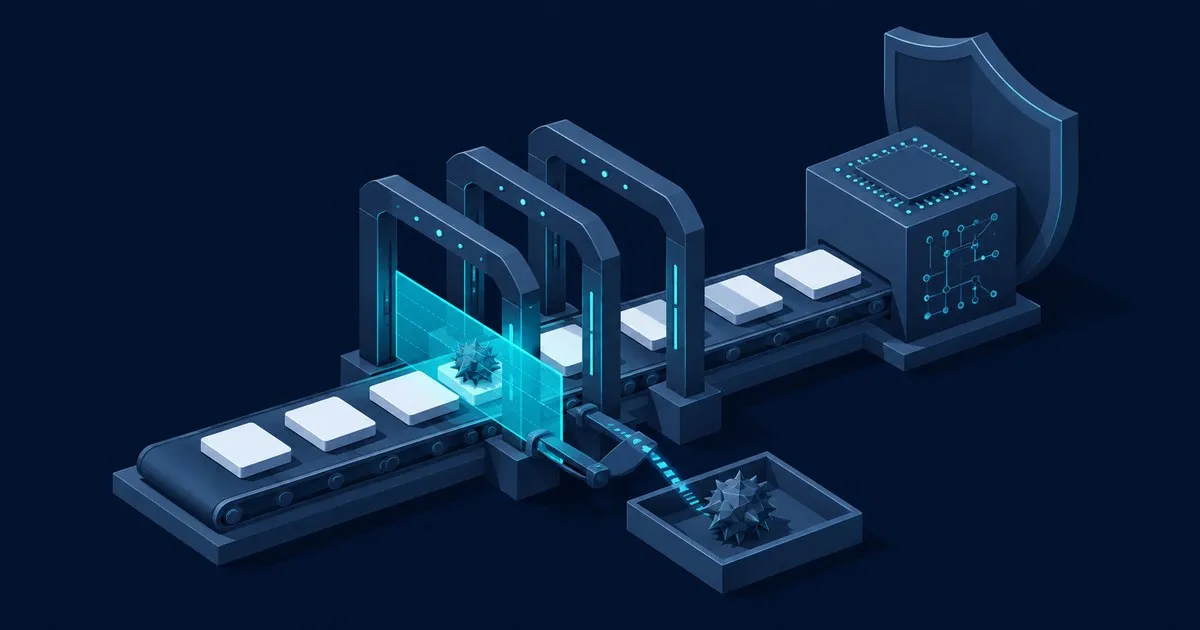
Before a scanner is added, the path is: client input → application → LLM → response → client. Inserting a cloud-native guardrail or Lakera Guard adds one round trip on the input side and, if you enable output scanning, a second round trip after generation — the app calls the guardrail API, gets a flag/score back, then decides whether to forward the prompt. A self-hosted classifier like Prompt Guard 2 runs in-process or as a local sidecar instead of an external call, which removes the network hop but shifts the burn of hosting, scaling, and updating the model onto your own infrastructure.
For RAG pipelines and agents, the scanner also needs a seat further upstream — screening retrieved documents and tool outputs before they’re concatenated into context, not just the user’s original message. This is the indirect-injection half of LLM01, and it’s the half a chat-turn-only scanner will not catch. aisec.blog’s breakdown of direct versus indirect prompt injection is a useful reference for mapping which attack surface each tool in this list actually covers before you commit to one.
Trade-offs
None of these tools should be evaluated as a standalone control, and OWASP’s own mitigation list backs that up — it recommends input/output filtering alongside privilege limitation, human approval for high-risk actions, and untrusted-content segregation, not filtering on its own. A scanner is one layer in that stack, not a replacement for the rest of it.
On robustness specifically, an arXiv analysis of evasion attacks against prompt injection and jailbreak detection systems tested ProtectAI’s DeBERTa-based detectors, Microsoft’s content filter, and LLaMA-based safety mechanisms against adversarial rewrites generated with standard NLP attack frameworks such as TextFooler and BERT-Attack, and found current detectors can be evaded with sufficiently crafted paraphrases. That’s a general property of classifier-based defenses, not a flaw unique to one vendor — but it argues for layering a scanner with output validation and privilege limiting rather than trusting the input filter alone to hold the line.
Integration effort scales roughly with how much control you want. Cloud-native guardrails are near zero-effort if you’re already on that cloud — a config toggle or a parameter on an existing API call — but lock you to that provider and add SaaS latency to every request. Lakera Guard is cloud-agnostic and a single API integration, at the cost of sending prompt content to a third party. Self-hosted classifiers require you to provision and maintain inference infrastructure, but keep data in-house and avoid per-request vendor billing. None of the vendor pages reviewed here publish independently audited false-positive rates or p95 latency figures, so treat any specific number a vendor quotes as a claim to verify against your own traffic before committing budget. For which published suites measure this and what each can and cannot tell you, see the reference to published AI security benchmark suites; for a method that produces a number you can trust, see how to benchmark a prompt-injection detector honestly.
One deployment risk is now concrete rather than theoretical: Protect AI’s LLM Guard — previously one of the most cited open-source options, with input scanners for prompt injection and output scanners for factual consistency and toxicity — was archived by its maintainers on July 9, 2026, following Palo Alto Networks’ acquisition of Protect AI. The MIT-licensed code still runs and existing deployments aren’t broken, but there are no further scanner updates, new detection models, or security patches coming. Anyone building a new pipeline today should treat it as a dead end, not a shortlist candidate. Protect AI’s rebuff, an earlier injection detector from the same org, was archived earlier still — a pattern worth noting before standardizing on any single open-source vendor’s tooling stack.
Who should pick what
Teams standardized on one cloud (Azure Foundry, Bedrock, or Vertex) and wanting the fastest path to a first layer of defense should start with that cloud’s native guardrail — Prompt Shields, Bedrock Guardrails, or Model Armor. Teams running a multi-vendor model stack, or evaluating models across providers, are better served by a model-agnostic external firewall like Lakera Guard, which doesn’t care which LLM sits behind it. Teams with data-residency constraints, air-gapped environments, or the in-house ML platform capacity to own model updates should lean toward self-hosted classifiers — Prompt Guard 2 for a lightweight drop-in check, NeMo Guardrails when a programmable rules layer matters as much as the classifier itself. For a wider view of where injection scanning sits relative to output filtering, PII redaction, and other guardrail categories, GuardML’s guardrails resource hub is a reasonable next stop.
Nobody should be starting a new integration against LLM Guard or rebuff at this point, and nobody should treat any single scanner — cloud or self-hosted — as sufficient on its own. OWASP’s mitigation list is explicit that filtering is one control among several, and the evasion research above is a reminder that classifier-based detection specifically has known blind spots against adversarial input.


